
For four nights in October, Cincinnati let its buildings become screens. Our media team spent the festival on the sidewalks, necks craned, talking projection mapping with the artists, creators and projectionists who make it happen. We came home with a camera roll full of facades and one idea we keep bringing into client work.
QUICK ANSWER
Blink 2026 (October 8 to 11) is a free light and art festival across downtown Cincinnati and Covington, featuring large-scale projection mapping, light installations and murals over more than 30 city blocks. Our biggest takeaway: the projections people remembered were designed with a building's architecture, not just placed on top of it. That same principle shapes how we design branded environments and event spaces.
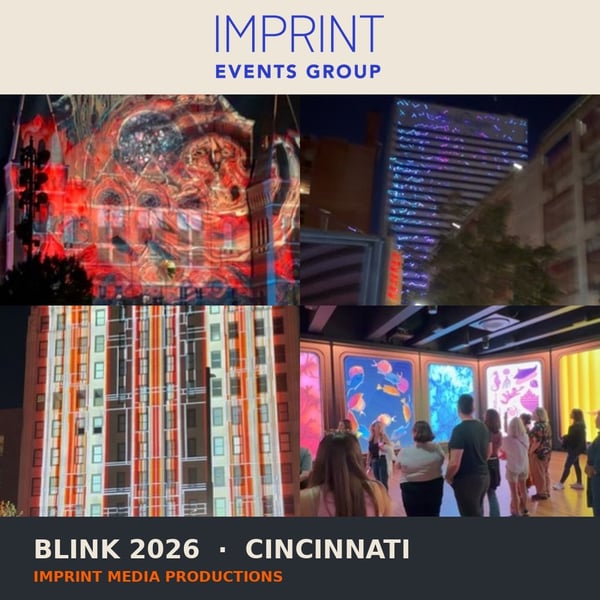
What is Blink Cincinnati?
Blink is a biennial light and art festival that turns Cincinnati's urban core and Northern Kentucky into an open-air gallery. It launched in 2017, and the 2024 edition drew more than two million people. The festival bills itself as 80+ large-scale projection mappings, alongside light installations and murals, spread over more than 30 city blocks. This year it ran October 8 to 11 in downtown Cincinnati and Covington.
It's free, which means the audience is everyone: families, date nights, art students, and at least one events team taking notes on the curb.
Which projections stood out at Blink 2026?
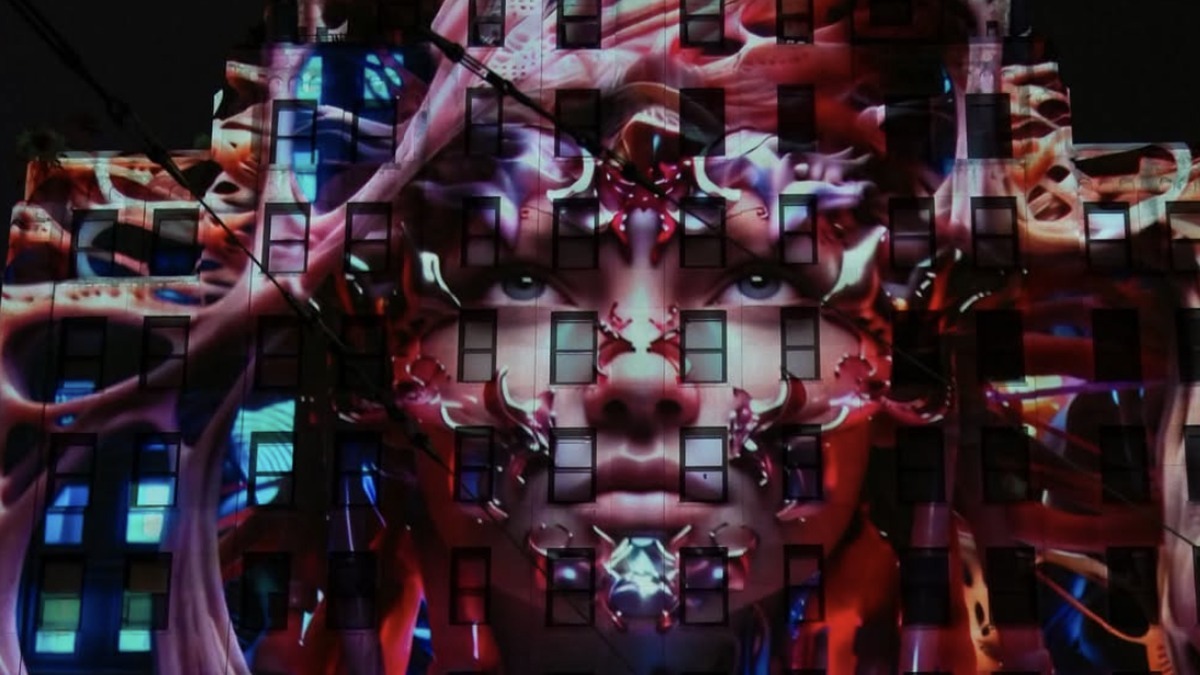
Four pieces stuck with us: Music Hall's historic facade wrapped in red and blue, a modern office tower traced in fine violet linework, an Art Deco tower wearing stripes on its stripes, and a gallery room where the art surrounds you instead of hanging in front of you.
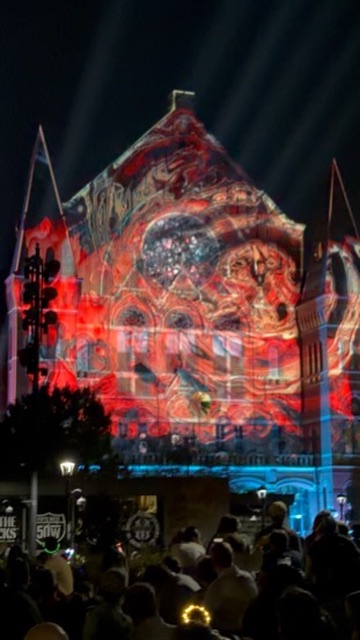
Music Hall, full wrap
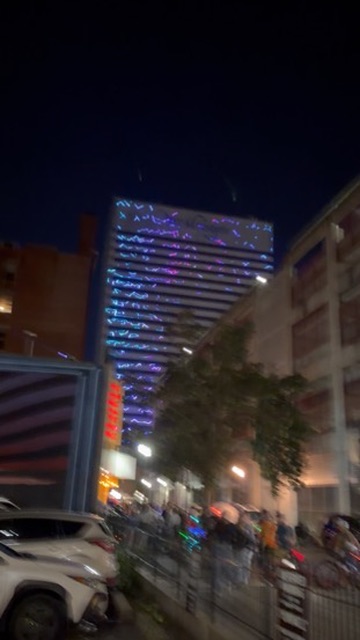
Modern tower, linework
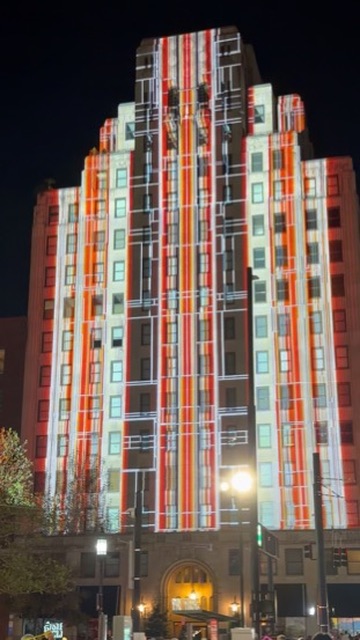
Art Deco, stripes on stripes
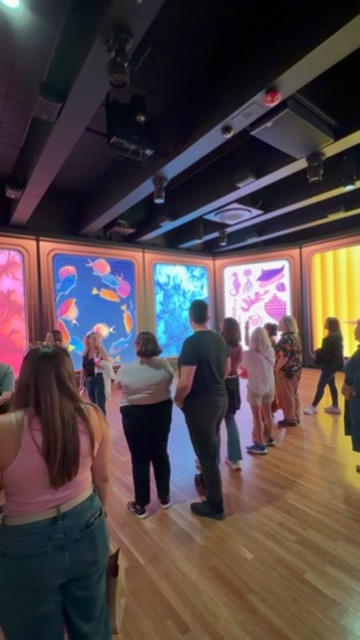
Immersive gallery room
The best pieces worked with the building, not on top of it.
The Art Deco tower is the one we keep talking about. Its projected stripes ran with the building's own verticals, so the light read as part of the architecture instead of a video playing on a wall. It's a useful lens for any branded environment: start with the structure, then decide what goes on it. Every room already has a shape. The strongest design listens to it.
What do projectionists think about that renderings don't?
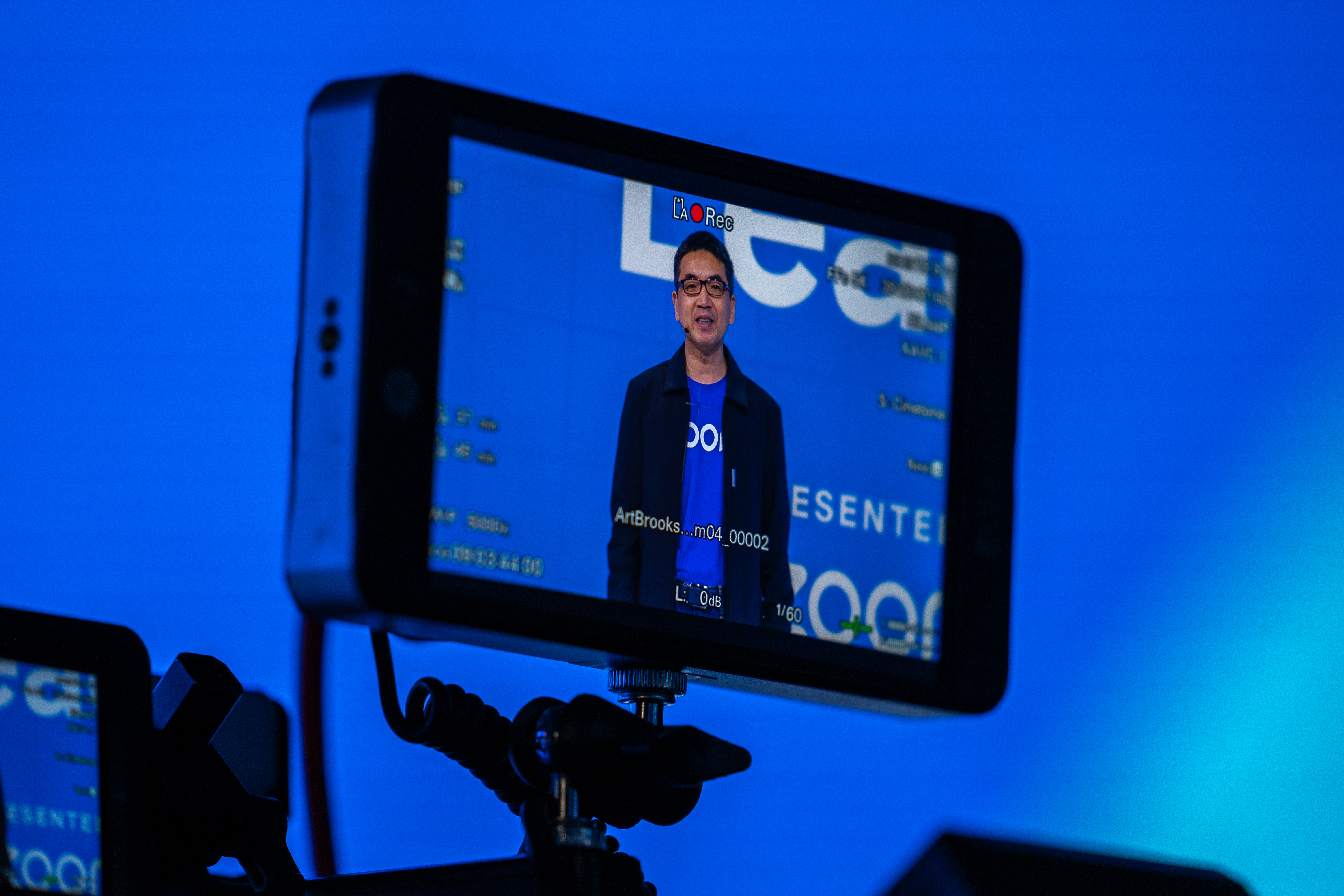
We talked with digital artists, content creators and video projectionists, and each group watched the festival through a different lens. The artists talked about the idea. The projectionists talked about throw distance, wind, and whether the piece would still look right at 11 pm on a real brick facade in real October weather.
Both conversations matter, and the second one is where a lot of experiences are quietly won or lost. A rendering can look flawless on a laptop and fall apart on mortar lines. That's why we like technical production in the room early, while the idea is still flexible enough to work with the space instead of against it.
Where can you host an immersive event in Cincinnati?
While we were out, our team found Mercantile Immersive, a private event venue inside the historic Mercantile building on Walnut Street. Floor-to-ceiling LED walls, 360-degree projection mapping and spatial audio mean guests walk through the content instead of watching it from a seat. The space holds up to 500 guests across roughly 14,000 square feet.
For client dinners, launches and activations, a room like that hands you a finished environment on day one, so the creative energy goes into the story instead of the scaffolding. It's on our shortlist for clients weighing Cincinnati as their next conference city.
How does projection mapping work?
Every projection moves through the same four steps. The order matters, because each step depends on the one before it.
- Baking. Lighting, textures and shadows get converted into flat 2D image maps ahead of time, so the media server isn't calculating 3D geometry mid-show. This is how a flat wall appears to cave in or pop out.
- Compositing. Baked elements are layered with live-action effects, text and color correction. Digital masks trace the building's exact lines, so light lands on columns and panels and stays off the windows and doors.
- Rendering. The composited work exports as a video file or real-time stream built for media servers. Every layer, mask and frame rate is locked in, so playback runs without lag.
- Projecting. A media server drives high-powered projectors, and technicians use warping and keystoning tools to line the image up with the building's real corners and curves.
Key takeaways
- Design with the architecture. The projections people stopped for followed the building's own lines.
- Plan for the real venue, not the rendering. Weather, distance and surface texture decide whether a concept survives opening night.
- Bring technical voices in early, while the idea can still flex.
- Immersive venues like Mercantile Immersive give planners a finished environment from day one.
IMPRINT MEDIA PRODUCTIONS
Have a building, a ballroom or a blank wall that needs a story?
We handle technical production, creative production, creative design and media services under one roof. Bring us the structure and the idea, and we'll work out the rest together.
Frequently asked questions
When was Blink 2026?
Blink 2026 ran from October 8 to 11, 2026, in downtown Cincinnati and Covington, Kentucky.
Is Blink Cincinnati free?
Yes. Blink is free and open to the public, with installations spread across more than 30 city blocks.
What is projection mapping?
Projection mapping is a technique that projects video onto three-dimensional surfaces, like building facades, using digital masks and warping so the content fits the exact shape of the surface.
Can projection mapping be used for corporate events?
Yes. The same process that wraps a building at Blink can transform a ballroom wall, a stage set, a product reveal or a venue facade, anywhere a surface can become part of the story.
What is Mercantile Immersive?
Mercantile Immersive is a private event venue in downtown Cincinnati with floor-to-ceiling LED walls, 360-degree projection mapping and spatial audio. It holds up to 500 guests.
Sources
- BLINK Cincinnati, About BLINK
- FOX19, BLINK 2026 dates announced
- NKY Tribune, BLINK coming Oct. 8 to 11
- WCPO, BLINK 2026 festival map
- Mercantile Immersive brings Sphere vibes to Cincinnati
Photos by Imprint Media Productions.